 Sébastien Helleu
6f979f2e95
Sébastien Helleu
6f979f2e95
Refactor the theme registry to store one sub-table per contributor
instead of a single merged hashtable. Each registered theme now holds
a linked list of t_theme_contribution entries:

  struct t_theme_contribution {
      struct t_weechat_plugin *plugin;  /* NULL = core */
      const void *script;               /* NULL for non-script */
      struct t_hashtable *overrides;
      ...
  };

Identity of a contributor is the (plugin, script) pair:

  - (NULL, NULL)     -> core (theme_builtin_init)
  - (plugin, NULL)   -> plugin-level contribution
  - (plugin, script) -> individual script (filled in by next commit)

theme_register is now (plugin, script, name, overrides). It searches
the existing contributions for a matching (plugin, script) and merges
the new overrides into it; otherwise it appends a fresh contribution.
The public macro weechat_theme_register(name, overrides) still takes
two args - it now expands to pass weechat_plugin and NULL for script.

theme_apply iterates contributions in list order, calling
config_file_option_set for each entry; later contributions naturally
win for duplicate keys.

Two new internal helpers prepare for the lifecycle work in the next
two commits:

  - theme_unregister_plugin (plugin): drops every contribution owned
    by that plugin (with script == NULL).
  - theme_unregister_script (plugin, script): drops every contribution
    owned by that script.

Neither is called yet; the auto-purge wiring lands in commits 24
(plugin_unloaded signal) and 25 (script API + script-unload hook).

Other touched code:

  - core-theme-builtin.c switches to theme_register (NULL, NULL, ...).
  - core-command.c /theme info uses theme_overrides_count helper
    instead of reaching into theme->overrides (which no longer
    exists).
  - WEECHAT_PLUGIN_API_VERSION bumped to 20260527-01 (function-pointer
    signature change).

Two new tests cover the new semantics:

  - UnregisterByOwner: registers four contributions from distinct
    (plugin, script) pairs, then prunes by plugin and by script,
    asserting per-contribution removal.
  - RegisterMergesPerContributor: two successive register calls from
    the same (plugin, script) merge into a single contribution with
    later keys overriding earlier ones.

Existing tests are updated to use the new theme_register signature,
theme_overrides_count, and theme_get_override (replacing direct
access to theme->overrides->items_count and hashtable_get on
theme->overrides). No plugin or script call sites change - the
public weechat_theme_register macro keeps the same shape.
WeeChat






WeeChat (Wee Enhanced Environment for Chat) is a free chat client, fast and light, designed for many operating systems.
It is highly customizable and extensible with scripts.
Homepage: https://weechat.org/
Features
- Modular chat client: WeeChat has a lightweight core and optional plugins. All plugins (including IRC) are independent and can be unloaded.
- Multi-platform: WeeChat runs on GNU/Linux, *BSD, GNU/Hurd, Haiku, macOS and Windows (WSL and Cygwin).
- Multi-protocol: WeeChat is designed to support multiple protocols via plugins, like IRC.
- Standards-compliant: the IRC plugin is compliant with RFCs 1459, 2810, 2811, 2812, 2813 and 7194.
- Small, fast, and very light: the core is and should stay as light and fast as possible.
- Customizable and extensible: there are a lot of options to customize WeeChat, and it is extensible with C plugins and scripts (Perl, Python, Ruby, Lua, Tcl, Scheme, JavaScript and PHP).
- Fully documented: there is comprehensive documentation, which is translated into several languages.
- Developed from scratch: WeeChat was built from scratch and is not based on any other client.
- Free software: WeeChat is released under GPLv3.
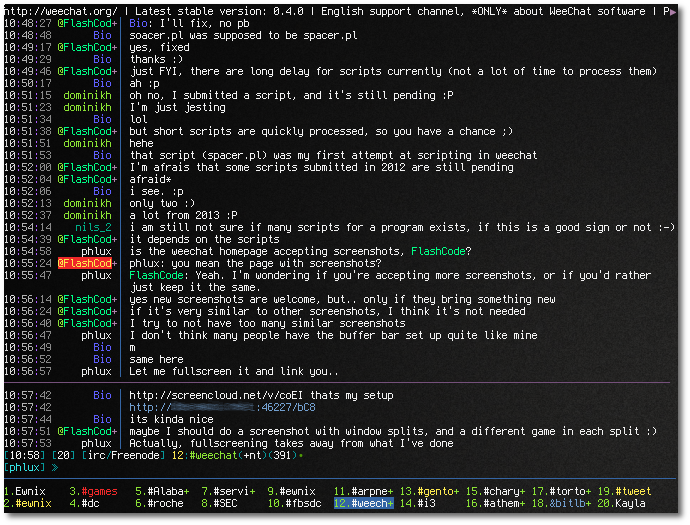
On WeeChat's website you can find more screenshots.
Installation
WeeChat can be installed using your favorite package manager (recommended) or by compiling it yourself.
For detailed instructions, please check the WeeChat user's guide.
Semantic versioning
WeeChat follows "practical" semantic versioning; see CONTRIBUTING.md.
Copyright
Copyright © 2003-2026 Sébastien Helleu
This file is part of WeeChat, the extensible chat client.
WeeChat is free software; you can redistribute it and/or modify it under the terms of the GNU General Public License as published by the Free Software Foundation; either version 3 of the License, or (at your option) any later version.
WeeChat is distributed in the hope that it will be useful, but WITHOUT ANY WARRANTY; without even the implied warranty of MERCHANTABILITY or FITNESS FOR A PARTICULAR PURPOSE. See the GNU General Public License for more details.
You should have received a copy of the GNU General Public License along with WeeChat. If not, see https://www.gnu.org/licenses/.