 Trygve Aaberge
ca07c03bf3
Trygve Aaberge
ca07c03bf3
If a request repeats the same header name multiple times, merge the
header values into a comma separated string. Previously, only the last
header specified would be used.

For header fields that are defined as a comma-separated list, a client
may choose to send it as multiple headers instead of one header with
comma-separated values. The specification says that these are
equivalent, so we can therefore join the headers into a comma-separated
string.

This is specified at https://datatracker.ietf.org/doc/html/rfc7230#section-3.2.2
which says:

    A sender MUST NOT generate multiple header fields with the same field
    name in a message unless either the entire field value for that
    header field is defined as a comma-separated list [i.e., #(values)]
    or the header field is a well-known exception (as noted below).

    A recipient MAY combine multiple header fields with the same field
    name into one "field-name: field-value" pair, without changing the
    semantics of the message, by appending each subsequent field value to
    the combined field value in order, separated by a comma.  The order
    in which header fields with the same field name are received is
    therefore significant to the interpretation of the combined field
    value; a proxy MUST NOT change the order of these field values when
    forwarding a message.
WeeChat








WeeChat (Wee Enhanced Environment for Chat) is a free chat client, fast and light, designed for many operating systems.
It is highly customizable and extensible with scripts.
Homepage: https://weechat.org/
Features
- Modular chat client: WeeChat has a lightweight core and optional plugins. All plugins (including IRC) are independent and can be unloaded.
- Multi-platform: WeeChat runs on GNU/Linux, *BSD, GNU/Hurd, Haiku, macOS and Windows (Bash/Ubuntu and Cygwin).
- Multi-protocols: WeeChat is designed to support multiple protocols by plugins, like IRC.
- Standards-compliant: the IRC plugin is compliant with RFCs 1459, 2810, 2811, 2812, 2813 and 7194.
- Small, fast, and very light: the core is and should stay as light and fast as possible.
- Customizable and extensible: there are a lot of options to customize WeeChat, and it is extensible with C plugins and scripts (Perl, Python, Ruby, Lua, Tcl, Scheme, JavaScript and PHP).
- Fully documented: there is comprehensive documentation, which is translated into several languages.
- Developed from scratch: WeeChat was built from scratch and is not based on any other client.
- Free software: WeeChat is released under GPLv3.
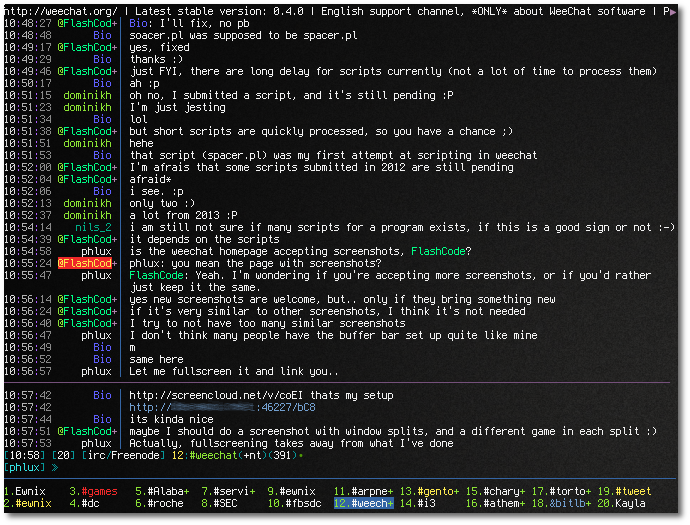
On WeeChat's website you can find more screenshots.
Installation
WeeChat can be installed using your favorite package manager (recommended) or by compiling it yourself.
For detailed instructions, please check the WeeChat user's guide.
Semantic versioning
WeeChat is following a "practical" semantic versioning, see file CONTRIBUTING.md.
Copyright
Copyright © 2003-2024 Sébastien Helleu
This file is part of WeeChat, the extensible chat client.
WeeChat is free software; you can redistribute it and/or modify it under the terms of the GNU General Public License as published by the Free Software Foundation; either version 3 of the License, or (at your option) any later version.
WeeChat is distributed in the hope that it will be useful, but WITHOUT ANY WARRANTY; without even the implied warranty of MERCHANTABILITY or FITNESS FOR A PARTICULAR PURPOSE. See the GNU General Public License for more details.
You should have received a copy of the GNU General Public License along with WeeChat. If not, see https://www.gnu.org/licenses/.